When you sell shares or mutual fund units for more than you paid, the profit is a capital gain, and it's taxed separately from your salary.
The rates in one table
| What you sold | Held for | Tax |
|---|---|---|
| Listed shares, equity mutual funds | 12 months or less | 20% (short-term) |
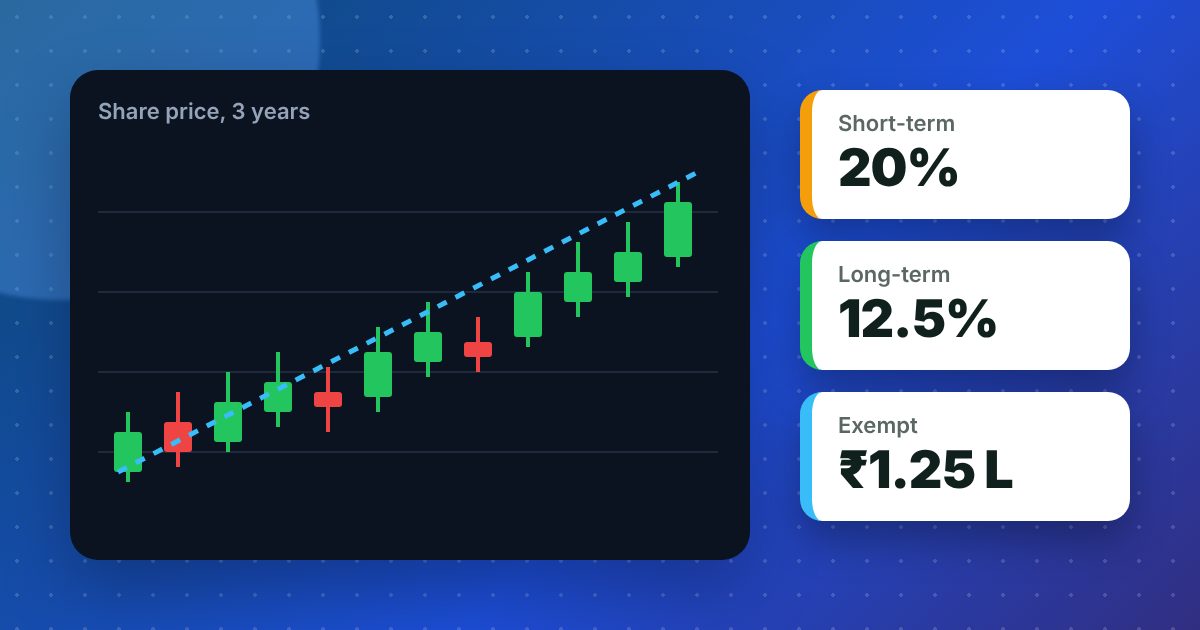
| Listed shares, equity mutual funds | More than 12 months | 12.5% on gains above ₹1.25 lakh a year (long-term) |
| Debt mutual funds bought on or after 1 April 2023 | Any period | Your income tax slab rate |
Add 4% cess to the tax. Surcharge can also apply at high incomes.
Example 1: long-term gain on shares
You bought shares for ₹5 lakh in January 2024 and sold them for ₹8 lakh in October 2026.
- Gain: ₹3,00,000. Held for more than 12 months, so it's long-term.
- First ₹1,25,000 is exempt. Taxable: ₹1,75,000.
- Tax at 12.5%: ₹21,875, plus cess = ₹22,750.
Example 2: short-term gain
Bought for ₹5 lakh in January 2026, sold for ₹6 lakh in October 2026.
- Gain: ₹1,00,000, held 8 months, so short-term.
- Tax at 20%: ₹20,000, plus cess = ₹20,800.
Example 3: debt fund
Bought a debt fund for ₹5 lakh in June 2023 and sold for ₹6 lakh. The ₹1 lakh gain is added to your income. In the 30% slab that's ₹31,200 with cess, however long you held it.
Capital Gains Tax CalculatorTax on selling shares and mutual funds: short or long term, with the ₹1.25 lakh exemption.Open →Shares bought before February 2018
Long-term gains made before 31 January 2018 were tax-free, and they still are. For shares bought earlier, your cost is taken as the higher of what you paid and the price on 31 January 2018 (but not more than your sale price). Our calculator asks for that price when your buy date is before 2018.
Ways to pay less, legally
- Use the ₹1.25 lakh exemption every year. Selling and rebuying long-term holdings to book gains up to the limit is called tax harvesting.
- Hold equity for more than 12 months where it makes sense: 12.5% beats 20%.
- Set off losses. Short-term losses can be set off against any capital gain, long-term losses only against long-term gains. Unused losses carry forward for 8 years if you file your return on time.
Rules for unlisted shares, property and gold are different. Check with a tax adviser for those.