If you have a daughter under 10, Sukanya Samriddhi Yojana (SSY) is one of the best safe investments in India. PPF is the other popular choice. Here is how they compare.
Interest rates right now
For the October–December 2026 quarter, Sukanya Samriddhi pays 8.2% and PPF pays 7.1% a year. The government reviews both every quarter. Interest and maturity are tax-free for both.
Side by side
| Sukanya Samriddhi | PPF | |
|---|---|---|
| Who can open | Parent of a girl under 10 | Any resident Indian |
| Yearly deposit | ₹250 to ₹1.5 lakh | ₹500 to ₹1.5 lakh |
| You deposit for | 15 years | 15 years (extendable in 5-year blocks) |
| Matures | 21 years after opening | After 15 years |
| Early money | Up to 50% after she turns 18, for education | Partial withdrawal from the 7th year |
| Rate (Oct–Dec 2026) | 8.2% | 7.1% |
How much each can grow to
Say you put in ₹1.5 lakh every year for 15 years (₹22.5 lakh in all):
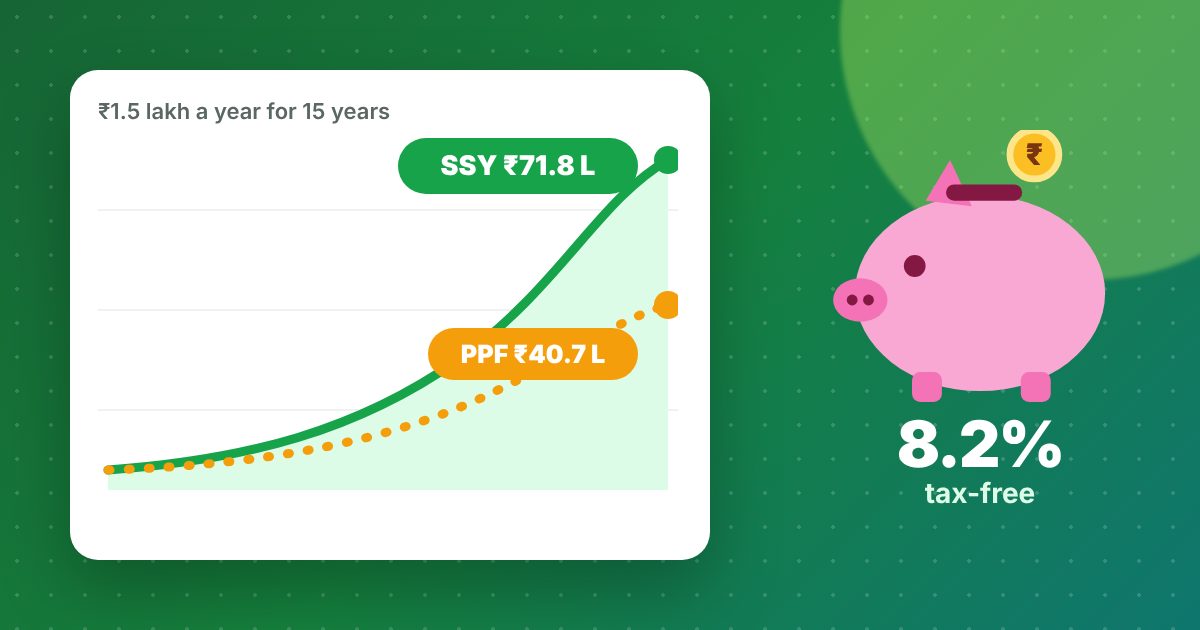
- Sukanya Samriddhi at 8.2%, opened in 2026: about ₹71.8 lakh when it matures in 2047. It keeps earning interest for 6 more years after you stop paying.
- PPF at 7.1% for 15 years: about ₹40.7 lakh.
Which should you choose?
- For a daughter's education or marriage fund: Sukanya Samriddhi. The higher rate and the extra 6 years of interest make a big difference.
- For your own long-term savings or retirement: PPF, because the money is in your name and you can extend it.
- Both together: you can, but the ₹1.5 lakh limit under section 80C (old regime) is shared across all 80C investments.
Things to know before you open SSY
- Open it at a post office or most big banks with the girl's birth certificate and the parent's ID and address proof.
- A family can open accounts for up to two daughters (more in the case of twins or triplets).
- Deposit at least ₹250 every year, or the account becomes inactive until you pay a small penalty.
Rates change every quarter. Our calculators always use the latest announced rate.