For most salaried people, the Employees' Provident Fund (EPF) is their biggest retirement saving, yet few know how much it will be worth.
Where your contribution goes
Every month, 12% of your basic salary + DA is deducted for EPF, and your employer adds another 12%. But not all of the employer's share reaches your PF:
- 8.33% of the employer's share goes to the pension scheme (EPS), capped at ₹1,250 a month (8.33% of ₹15,000).
- The rest goes into your EPF account.
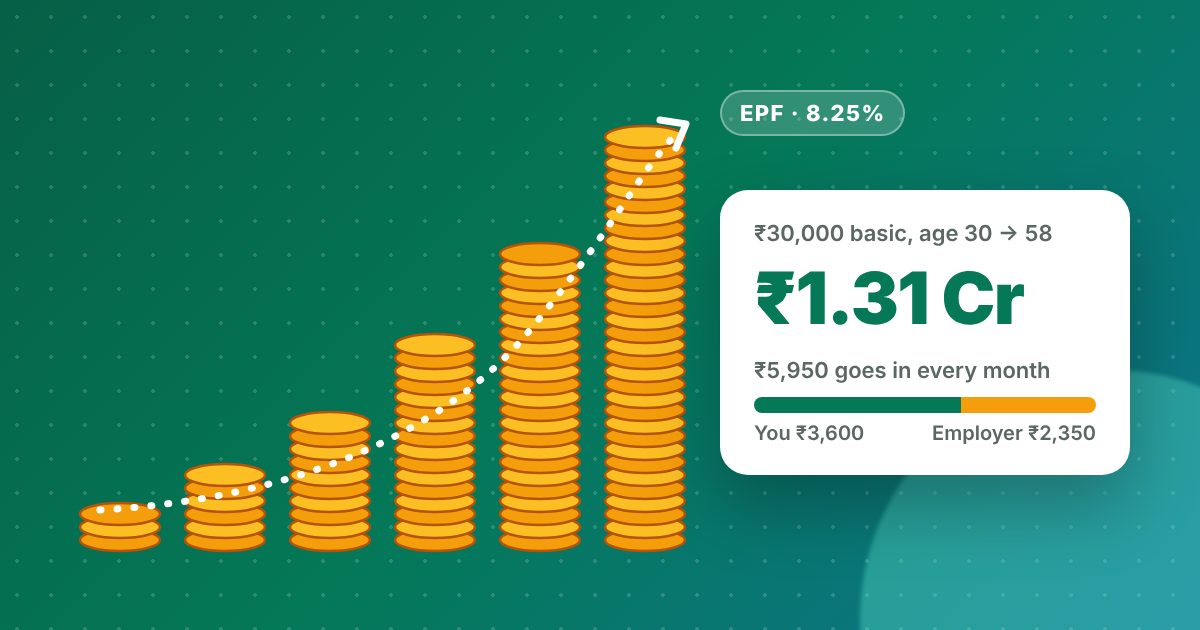
On a ₹30,000 basic salary:
| Per month | |
|---|---|
| Your share (12%) | ₹3,600 |
| Employer's share to EPF (₹3,600 − ₹1,250) | ₹2,350 |
| Total into EPF | ₹5,950 |
How big it can get
EPF interest for FY 2025-26 is 8.25%, and interest compounds every year. Starting at age 30 with a ₹30,000 basic:
- No pay rise until 58: about ₹74 lakh
- 5% yearly raise: about ₹1.31 crore, of which about ₹46 lakh is your and your employer's money and the rest is interest
Tax on EPF
- Your contribution counts for the section 80C deduction in the old regime.
- Interest is tax-free, except on your own contributions above ₹2.5 lakh a year (₹5 lakh if your employer doesn't contribute). Only very high earners cross this.
- Withdrawals are tax-free after 5 years of continuous service. Moving jobs doesn't break this if you transfer your PF to the new employer.
Habits that grow your PF
- Always transfer your PF when you change jobs instead of withdrawing it. Your UAN stays the same.
- Avoid early withdrawals unless you really need them. Every ₹1 lakh taken out at 30 is roughly ₹9–10 lakh less at 58.
- Consider VPF (voluntary PF). You can put in more than 12% and it earns the same rate, within the tax-free limit above.
- Check your passbook on the EPFO member portal once a year to make sure your employer is depositing.
The EPF rate is announced every year; our calculator uses the latest one.